

Rumination Exit Worksheet
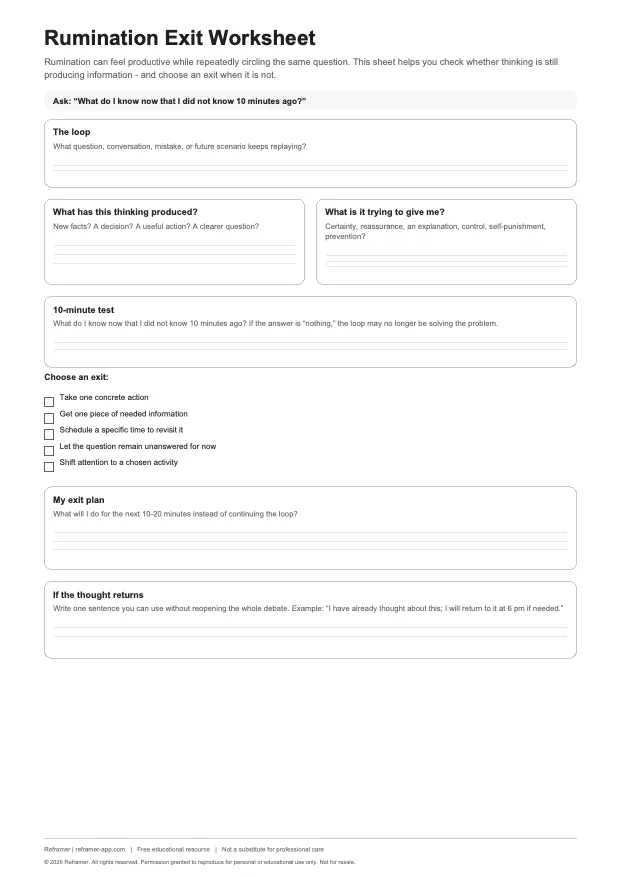
A rumination exit worksheet helps you check whether repeated thinking is still producing useful information. It asks what question keeps returning, what the loop is trying to provide and what you know now that you did not know ten minutes ago. You then choose an exit: action, information, a scheduled review, allowing an unanswered question or shifting attention. It is not a demand to suppress thoughts or solve the question before continuing your day.
Free · A4 · Printable · Fillable PDF · No sign-up
Fillable fields work in most modern PDF readers. If your browser does not save entries correctly, download the PDF and open it in a compatible PDF app.
Entries typed into the downloaded worksheet remain in your PDF file; this page does not receive the text you enter.
What this worksheet helps with
- Recognizing repetitive thought loops
- Separating reflection from unproductive replay
- Choosing a specific next activity
- Responding when the same thought returns
When to use it
- When you replay an awkward interaction after getting home
- When analysis leaves you more distressed but no better informed
- When you keep revisiting a mistake without finding a new step
How to use the worksheet
The loop
Name the question, conversation or situation that keeps replaying.
What has this thinking produced?
Check for new facts, a decision, useful action or a clearer question.
What is it trying to give me?
Notice the search for certainty, reassurance, control or self-punishment.
10-minute test
Compare what you know now with ten minutes ago. No new information may mean thinking is no longer solving the problem.
Choose an exit
Select action, information, a scheduled review, leaving the question unanswered or a chosen activity.
My exit plan
Name what you will actually do for the next 10–20 minutes.
If the thought returns
Write one reminder that lets you continue without reopening the whole debate.
Completed example
The same everyday scenario appears in the completed-example PDF. It illustrates one possible response, rather than an answer you need to copy.
- The loop
- At dinner I interrupted a friend and made a joke that landed awkwardly. Since getting home I keep replaying it and asking whether I sounded rude.
- What has this thinking produced?
- No new facts. I have replayed the same few seconds and feel more embarrassed than I did earlier.
- What is it trying to give me?
- Certainty that my friend is not offended and reassurance that I did not make a bad impression.
- 10-minute test
- I know the same things I knew ten minutes ago. The loop is not producing an answer because I cannot know exactly what my friend thought.
- My exit plan
- Write down one useful option: if I am still concerned tomorrow, I can send a simple check-in. For tonight, put my phone down and finish the book I was reading.
- If the thought returns
- Remind myself: “I already reviewed this. There is no new information right now. I can revisit it tomorrow if there is a real reason to.”
Tips for getting more from the exercise
- Choose a concrete activity, not “stop overthinking.”
- A returning thought does not mean the exit plan failed.
- Avoid filling the sheet repeatedly to obtain reassurance about the same question.
What this worksheet cannot tell you
This worksheet cannot diagnose rumination or guarantee relief. If thought loops are persistent, distressing or interfere with everyday life, consider support from a qualified mental-health professional.
Related guides
Explore the ideas behind this exercise.
Related worksheets
A Reframer exercise
Worry, Problem or Uncertainty?
Decide whether a worry needs action, information or a willingness to leave something unanswered for now.
How to use this worksheetA Reframer exercise
Facts, Predictions & Actions Worksheet
Separate what you know from what your mind predicts, then identify whether there is anything useful you can do.
How to use this worksheetAutomatic Thoughts Worksheet
Capture the thought that appeared in a difficult moment before you had time to evaluate it.
How to use this worksheetPrefer a guided experience?
Reframer brings some of the same principles into a guided experience: examining a thought, making a plan, allowing uncertainty or testing a prediction. Sometimes you need a reframe. Sometimes you need a plan.
These worksheets are provided for education and self-reflection. They are not a diagnosis, medical advice or a substitute for care from a qualified healthcare or mental-health professional. These worksheets may be downloaded, printed and reproduced for personal or educational use. They may not be resold, repackaged as another product, or redistributed commercially without prior permission.