

Cognitive Reframing Worksheet
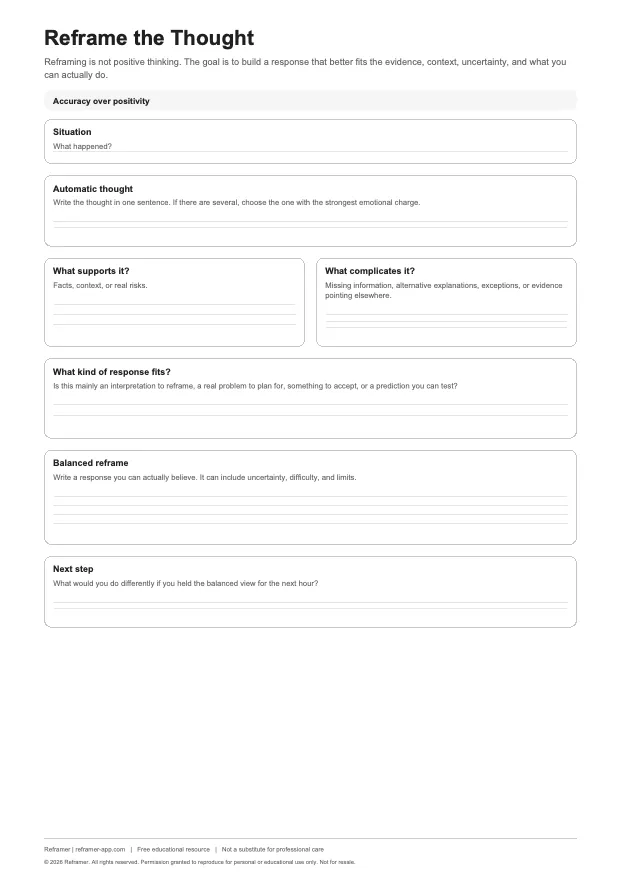
A cognitive reframing worksheet helps you examine one interpretation and write a response that better fits the evidence and context. It asks what supports the thought, what complicates it and what kind of response the situation actually needs. Reframing is not positive thinking or persuading yourself that everything is fine. A credible response may still acknowledge disappointment, uncertainty, limits or a practical problem that needs action.
Free · A4 · Printable · Fillable PDF · No sign-up
Fillable fields work in most modern PDF readers. If your browser does not save entries correctly, download the PDF and open it in a compatible PDF app.
Entries typed into the downloaded worksheet remain in your PDF file; this page does not receive the text you enter.
What this worksheet helps with
- Examining upsetting interpretations
- Considering alternative explanations
- Responding to self-criticism
- Choosing a proportionate next step
When to use it
- When you keep replaying a difficult presentation
- When an interpretation feels more certain than the evidence
- After feedback or a mistake
How to use the worksheet
Situation
Describe the event without deciding what it means yet.
Automatic thought
Choose one thought with a strong emotional charge.
What supports it?
Note facts, context and any real risk.
What complicates it?
Include missing information, alternative explanations and evidence pointing elsewhere.
What kind of response fits?
Ask whether this is an interpretation to reframe, a problem to plan for, uncertainty to allow or a prediction to test.
Balanced reframe
Write a response you can believe, rather than the most reassuring sentence.
Next step
Choose what you would do differently in the next hour if you held that balanced view.
Completed example
The same everyday scenario appears in the completed-example PDF. It illustrates one possible response, rather than an answer you need to copy.
- Situation
- During a project presentation, a senior colleague challenged one of my assumptions and I paused before answering.
- Automatic thought
- Everyone could tell I did not know what I was talking about.
- What supports it?
- I paused for several seconds and needed to look back at one figure before answering.
- What complicates it?
- I answered the question, the discussion continued normally, my manager thanked me afterward, and another colleague asked for the deck.
- What kind of response fits?
- Reframe the interpretation. There is no practical problem to solve beyond noting the question for next time.
- Balanced reframe
- I hesitated on one question because I wanted to check the number. That was visible, but it does not show that everyone judged me as incompetent. The rest of the presentation continued normally.
- Next step
- Add a note on that assumption to my presentation file and then stop replaying the moment.
Tips for getting more from the exercise
- A useful reframe can start with “It is possible, but I do not know yet.”
- Do not reframe away a practical problem that needs a plan.
- Stop once you have a fair response; repeated rewriting can become another search for certainty.
What this worksheet cannot tell you
Reframing cannot guarantee an outcome or change another person’s behavior. It should not be used to dismiss harm or replace action when action is needed.
Related guides
Explore the ideas behind this exercise.
Related worksheets
CBT Thought Record
Examine a situation, its automatic thought, your emotions, the evidence and a more balanced response.
How to use this worksheetA Reframer exercise
Facts, Predictions & Actions Worksheet
Separate what you know from what your mind predicts, then identify whether there is anything useful you can do.
How to use this worksheetBehavioral Experiment Worksheet
Turn an anxious belief into a testable prediction, plan a safe experiment and compare expectations with observations.
How to use this worksheetPrefer a guided experience?
Reframer brings some of the same principles into a guided experience: examining a thought, making a plan, allowing uncertainty or testing a prediction. Sometimes you need a reframe. Sometimes you need a plan.
These worksheets are provided for education and self-reflection. They are not a diagnosis, medical advice or a substitute for care from a qualified healthcare or mental-health professional. These worksheets may be downloaded, printed and reproduced for personal or educational use. They may not be resold, repackaged as another product, or redistributed commercially without prior permission.