

Behavioral Experiment Worksheet
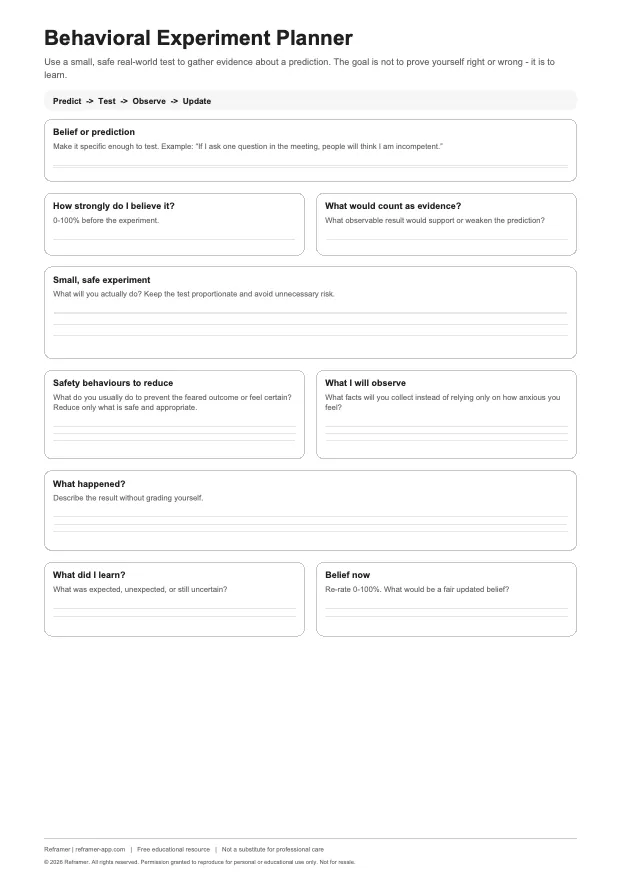
A behavioral experiment worksheet helps you turn a belief into a specific prediction and gather evidence through a small, safe real-world test. You decide what would count as evidence before acting, record what actually happens, then update the belief. The exercise is about learning, not proving anxiety wrong. A mixed result or unanswered question can still be informative, and the experiment should remain safe, ethical and proportionate.
Free · A4 · Printable · Fillable PDF · No sign-up
Fillable fields work in most modern PDF readers. If your browser does not save entries correctly, download the PDF and open it in a compatible PDF app.
Entries typed into the downloaded worksheet remain in your PDF file; this page does not receive the text you enter.
What this worksheet helps with
- Testing specific predictions
- Comparing expectations with outcomes
- Noticing reliance on excessive rehearsal
- Updating a belief using observable evidence
When to use it
- When you predict a small pause will ruin a presentation
- When you avoid a reasonable question at work
- When a belief can be tested without unnecessary risk
How to use the worksheet
Belief or prediction
Write a specific prediction with an observable outcome.
How strongly do I believe it?
Rate belief strength from 0–100 before testing.
What would count as evidence?
Decide which observations would support or weaken the prediction.
Small, safe experiment
Plan a manageable test in an appropriate situation.
Safety behaviours to reduce
Notice unnecessary rituals such as repeated rehearsal. Reduce only what is safe and appropriate; keep genuine precautions.
What I will observe
Choose facts you can collect instead of using anxiety alone as the result.
What happened?
Describe the outcome without grading yourself.
What did I learn?
Record expected, unexpected and unresolved parts.
Belief now
Re-rate the belief and write a fair update.
Completed example
The same everyday scenario appears in the completed-example PDF. It illustrates one possible response, rather than an answer you need to copy.
- Belief or prediction
- If I speak in the team meeting without rehearsing every sentence, I will ramble and people will think I am unprepared.
- How strongly do I believe it?
- 80/100 before the experiment.
- What would count as evidence?
- Whether I can make the point clearly enough, whether people understand it, and whether anyone reacts as if I am unprepared.
- Small, safe experiment
- Prepare three bullet points, not a script. Speak once during Thursday’s team meeting and allow myself to pause if I need to think.
- Safety behaviours to reduce
- Do not rehearse the exact wording repeatedly, apologize before speaking, or scan everyone’s face for signs of judgment.
- What I will observe
- Whether my point is understood, what people actually say or do, and how long the discomfort lasts.
- What happened?
- I spoke for about 35 seconds, paused once, and finished my point. My manager nodded and a colleague built on the idea. Nobody commented on the pause.
- What did I learn?
- I do not need a perfect script to contribute. A pause felt noticeable to me but did not stop the conversation.
- Belief now
- 45/100. I still prefer preparing, but the original prediction feels less convincing.
Tips for getting more from the exercise
- Define the evidence before running the test.
- Choose a modest experiment you can describe clearly.
- A feeling of embarrassment is not the same as evidence that others judged you.
What this worksheet cannot tell you
Do not test predictions through unsafe behavior, withholding medical care, changing medication or abandoning genuine safety precautions. Seek professional guidance for experiments involving trauma, severe distress or clinical exposure work.
Related guides
Explore the ideas behind this exercise.
Related worksheets
CBT Thought Record
Examine a situation, its automatic thought, your emotions, the evidence and a more balanced response.
How to use this worksheetCognitive Reframing Worksheet
Examine an upsetting interpretation and develop a more accurate and useful way of seeing the situation.
How to use this worksheetA Reframer exercise
Facts, Predictions & Actions Worksheet
Separate what you know from what your mind predicts, then identify whether there is anything useful you can do.
How to use this worksheetPrefer a guided experience?
Reframer brings some of the same principles into a guided experience: examining a thought, making a plan, allowing uncertainty or testing a prediction. Sometimes you need a reframe. Sometimes you need a plan.
These worksheets are provided for education and self-reflection. They are not a diagnosis, medical advice or a substitute for care from a qualified healthcare or mental-health professional. These worksheets may be downloaded, printed and reproduced for personal or educational use. They may not be resold, repackaged as another product, or redistributed commercially without prior permission.