

CBT Thought Record Worksheet
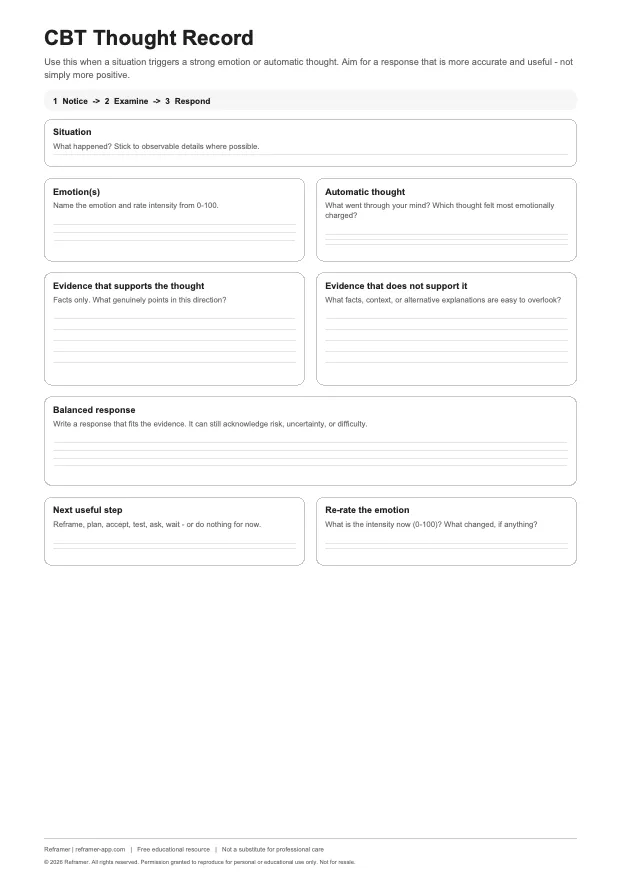
A CBT thought record is a structured way to slow down a difficult moment and examine the interpretation that followed. It puts the situation, emotions, automatic thought and available evidence side by side, then asks for a balanced response and a useful next step. The aim is a response that fits the facts, including any real difficulty or uncertainty. It is not an exercise in forcing yourself to feel positive.
Free · A4 · Printable · Fillable PDF · No sign-up
Fillable fields work in most modern PDF readers. If your browser does not save entries correctly, download the PDF and open it in a compatible PDF app.
Entries typed into the downloaded worksheet remain in your PDF file; this page does not receive the text you enter.
What this worksheet helps with
- Anxious predictions
- Negative automatic thoughts
- Difficult interactions
- Recurring self-critical thoughts
When to use it
- After receiving feedback at work
- After an interaction you keep replaying
- When an interpretation noticeably changes your mood
How to use the worksheet
Situation
Describe what happened using observable details. Separate the event from what you think it means.
Emotion(s)
Name each emotion and rate its intensity from 0–100. You can record more than one emotion.
Automatic thought
Write the thought that felt most emotionally charged. Use the actual words that came to mind.
Evidence that supports the thought
Record facts that genuinely support the interpretation, rather than repeating the fear.
Evidence that does not support it
Include relevant context, exceptions and facts you might be overlooking.
Balanced response
Write a response that accounts for both sides of the evidence. It can acknowledge uncertainty or a real problem.
Next useful step
Choose a proportionate action: revise, ask, plan, test, wait or do nothing for now.
Re-rate the emotion
Record its intensity again. A smaller change, or no immediate change, is still useful information.
Completed example
The same everyday scenario appears in the completed-example PDF. It illustrates one possible response, rather than an answer you need to copy.
- Situation
- My manager asked me to rewrite the opening slides 30 minutes before a client review.
- Emotion(s)
- Anxiety 78/100; embarrassment 60/100.
- Automatic thought
- She thinks I am incompetent and cannot trust my work.
- Evidence that supports the thought
- She said the opening was unclear and asked me to change it before the meeting.
- Evidence that does not support it
- She said the analysis was strong, asked two other people for edits, and has not raised performance concerns with me.
- Balanced response
- She wants this section clearer before the client sees it. That does not tell me what she thinks of my overall competence. I can make the requested change and judge the feedback on its actual content.
- Next useful step
- Rewrite the first two slides, then ask whether the revised opening works.
- Re-rate the emotion
- Anxiety 46/100. Still pressured, but less ashamed.
Tips for getting more from the exercise
- Work with one specific thought rather than your whole day.
- If evidence is missing, write “I do not know” rather than inventing a reassuring explanation.
- Judge the response by accuracy, not by how much it reduces anxiety.
What this worksheet cannot tell you
A thought record cannot establish what another person thinks or determine whether a medical symptom is anxiety. It cannot replace an assessment or make a genuinely unsafe situation safe.
Related guides
Explore the ideas behind this exercise.
Related worksheets
Automatic Thoughts Worksheet
Capture the thought that appeared in a difficult moment before you had time to evaluate it.
How to use this worksheetCognitive Distortions Worksheet
Look for thinking patterns such as catastrophizing, mind reading and all-or-nothing thinking without assuming the thought is false.
How to use this worksheetBehavioral Experiment Worksheet
Turn an anxious belief into a testable prediction, plan a safe experiment and compare expectations with observations.
How to use this worksheetPrefer a guided experience?
Reframer brings some of the same principles into a guided experience: examining a thought, making a plan, allowing uncertainty or testing a prediction. Sometimes you need a reframe. Sometimes you need a plan.
These worksheets are provided for education and self-reflection. They are not a diagnosis, medical advice or a substitute for care from a qualified healthcare or mental-health professional. These worksheets may be downloaded, printed and reproduced for personal or educational use. They may not be resold, repackaged as another product, or redistributed commercially without prior permission.