

Cognitive Distortions Worksheet
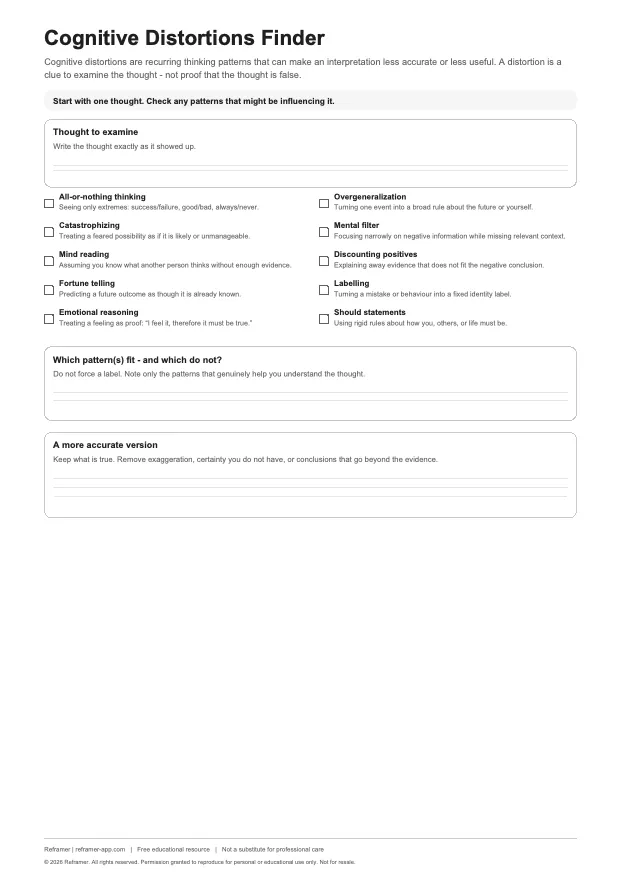
A cognitive distortions worksheet helps you examine how an interpretation may be shaped by familiar thinking patterns. Starting with one thought, you consider patterns such as mind reading, catastrophizing, emotional reasoning and mental filtering. A label is a clue to examine the evidence, not proof that a concern is wrong. The next step is to keep what is supported while removing exaggeration or certainty that the facts do not justify.
Free · A4 · Printable · Fillable PDF · No sign-up
Fillable fields work in most modern PDF readers. If your browser does not save entries correctly, download the PDF and open it in a compatible PDF app.
Entries typed into the downloaded worksheet remain in your PDF file; this page does not receive the text you enter.
What this worksheet helps with
- Recognizing all-or-nothing thinking
- Examining mind reading and catastrophizing
- Noticing overlooked context
- Separating feelings from evidence
When to use it
- After an interview or presentation
- When one mistake seems to define the whole outcome
- When you assume you know what someone else thinks
How to use the worksheet
Thought to examine
Write the interpretation exactly as it appeared.
Consider the patterns
Check only patterns that help explain this thought. All-or-nothing thinking overlooks the middle ground. Overgeneralization draws a sweeping conclusion from a small sample. Catastrophizing jumps to a feared outcome and underestimates your ability to respond. A mental filter leaves relevant context out of view. Mind reading assumes another person’s thoughts. Discounting positives dismisses evidence that complicates a negative conclusion. Fortune telling treats a prediction as settled. Labelling reduces a person to an identity based on one action. Emotional reasoning uses the strength of a feeling as evidence. Should statements turn preferences or expectations into inflexible demands. Several can overlap, and none by itself proves a concern false.
Which patterns fit — and which do not?
Explain the fit using the thought’s words. Do not force a label or dismiss a real risk.
A more accurate version
Retain supported facts while removing overstatement, fixed identity labels or conclusions beyond the evidence.
Completed example
The same everyday scenario appears in the completed-example PDF. It illustrates one possible response, rather than an answer you need to copy.
- Thought to examine
- I stumbled over one answer in the interview. They definitely thought I was unqualified, and I have blown my chance.
- Which patterns fit — and which do not?
- Mind reading fits because I am assuming what the panel thought. Catastrophizing and mental filtering also fit. I am focusing on one answer and treating it as decisive.
- A more accurate version
- I had one answer I wish I had handled better. I also answered the rest of the interview, and I do not know how the panel evaluated me. One awkward answer does not tell me the final outcome.
Tips for getting more from the exercise
- Several patterns can overlap; identifying all of them is not the goal.
- Use labels as questions, not criticism of yourself.
- If a concern is supported, decide what practical response it needs.
What this worksheet cannot tell you
Identifying a thinking pattern does not prove a thought false. The worksheet cannot rule out danger, discrimination or other real difficulties.
Related guides
Explore the ideas behind this exercise.
Related worksheets
Automatic Thoughts Worksheet
Capture the thought that appeared in a difficult moment before you had time to evaluate it.
How to use this worksheetCBT Thought Record
Examine a situation, its automatic thought, your emotions, the evidence and a more balanced response.
How to use this worksheetCognitive Reframing Worksheet
Examine an upsetting interpretation and develop a more accurate and useful way of seeing the situation.
How to use this worksheetPrefer a guided experience?
Reframer brings some of the same principles into a guided experience: examining a thought, making a plan, allowing uncertainty or testing a prediction. Sometimes you need a reframe. Sometimes you need a plan.
These worksheets are provided for education and self-reflection. They are not a diagnosis, medical advice or a substitute for care from a qualified healthcare or mental-health professional. These worksheets may be downloaded, printed and reproduced for personal or educational use. They may not be resold, repackaged as another product, or redistributed commercially without prior permission.