

CBT Triangle Worksheet
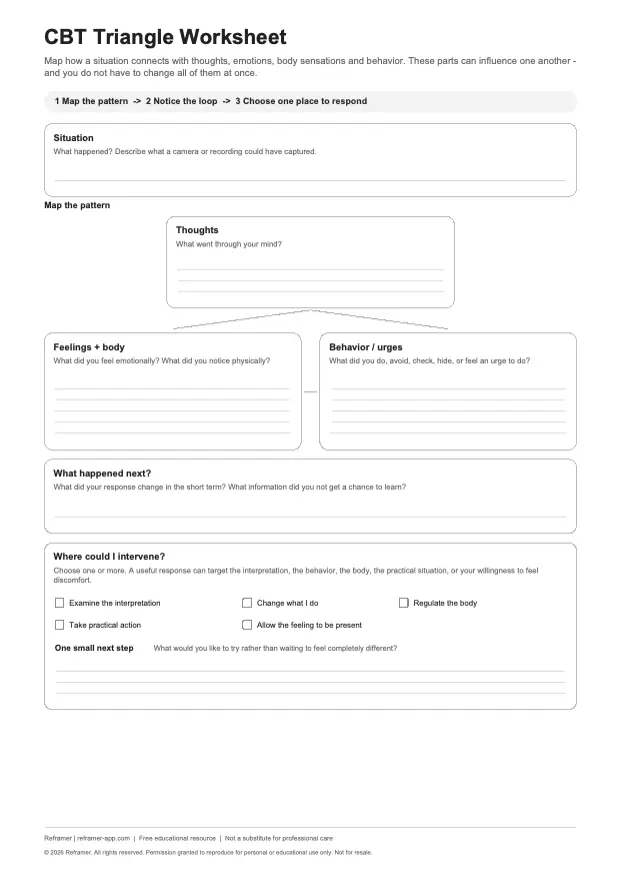
The CBT triangle, also called the cognitive triangle, helps you see how thoughts, emotions and behaviors can influence one another in a specific situation. Reframer's thoughts, feelings and behaviors worksheet also includes body sensations, what happened next and possible points of intervention. Map the pattern before deciding where to respond. You do not have to change every part of it, and not every difficult experience needs cognitive restructuring. Practical action, a change in behavior, body regulation or allowing a feeling may be more useful.
Free · A4 · Printable · Fillable PDF · No sign-up
Fillable fields work in most modern PDF readers. If your browser does not save entries correctly, download the PDF and open it in a compatible PDF app.
Entries typed into the downloaded worksheet remain in your PDF file; this page does not receive the text you enter.
What this worksheet helps with
- Understanding the CBT model through a specific situation
- Separating an event from the thought that followed
- Noticing how emotions, body sensations and behavior interact
- Choosing one manageable place to respond differently
When to use it
- When you are new to CBT and want to map an everyday experience
- When a social or work situation leads to avoidance
- When you are unsure whether to examine a thought, act or allow a feeling
How to use the worksheet
Situation
What happened? Write what a camera or recording could have captured, keeping observable details separate from your interpretation.
Thoughts
Write the words, images or predictions that went through your mind. A thought can feel convincing without being an established fact.
Feelings + body
Name the emotion and, if useful, rate its intensity from 0–100. Record physical sensations separately within the same field, such as warmth, muscle tension or a faster heartbeat.
Behavior / urges
What did you do, avoid, check or hide, and what did you feel an urge to do? Include what others could observe as well as quieter responses such as rehearsing internally.
What happened next?
Notice what your response changed in the short term and what you did not get a chance to learn. Thoughts, emotions, sensations and behavior can affect one another rather than following one fixed direction.
Where could I intervene?
Choose one or more of the PDF's interactive checkboxes: examine the interpretation; change what I do; regulate the body; take practical action; or allow the feeling to be present. You do not have to challenge the thought or remove the feeling before doing something useful.
One small next step
Choose a specific, proportionate response to try. It can preserve uncertainty and allow discomfort rather than waiting to feel completely different.
Completed example
The same everyday scenario appears in the completed-example PDF. It illustrates one possible response, rather than an answer you need to copy.
- Situation
- At a networking event, I introduced myself to someone. They checked their phone twice and ended the conversation after two minutes.
- Thoughts
- “I am boring. They were looking for a way to get away from me.”
- Feelings + body
- Embarrassment 70/100; anxiety 65/100. Hot face, tight chest, tense shoulders.
- Behavior / urges
- I stopped approaching people, stood near the wall checking my phone, and left the event earlier than planned.
- What happened next?
- Leaving early reduced my anxiety quickly, but I never found out whether another conversation would have gone differently.
- Where could I intervene?
- Examine the interpretation; change what I do; allow the feeling to be present.
- One small next step
- Stay for another 15 minutes and introduce myself to one more person. Notice the thought that I am boring, but treat it as an interpretation rather than a fact.
Tips for getting more from the exercise
- Start with one event rather than trying to map your whole day.
- Write feelings and body sensations as experiences, not proof of what another person thought.
- Choose one small response. You can stay with uncertainty without deciding that everyone liked you.
What this worksheet cannot tell you
The CBT triangle is a way to organize an experience, not a diagnosis or a complete explanation of its causes. The worksheet cannot determine another person's motives or the medical cause of physical symptoms. Seek appropriate support for persistent distress or concerning symptoms.
Related guides
Explore the ideas behind this exercise.
Related worksheets
Automatic Thoughts Worksheet
Capture the thought that appeared in a difficult moment before you had time to evaluate it.
How to use this worksheetCBT Thought Record
Examine a situation, its automatic thought, your emotions, the evidence and a more balanced response.
How to use this worksheetCognitive Distortions Worksheet
Look for thinking patterns such as catastrophizing, mind reading and all-or-nothing thinking without assuming the thought is false.
How to use this worksheetA Reframer exercise
Facts, Predictions & Actions Worksheet
Separate what you know from what your mind predicts, then identify whether there is anything useful you can do.
How to use this worksheetPrefer a guided experience?
Reframer brings some of the same principles into a guided experience: examining a thought, making a plan, allowing uncertainty or testing a prediction. Sometimes you need a reframe. Sometimes you need a plan.
These worksheets are provided for education and self-reflection. They are not a diagnosis, medical advice or a substitute for care from a qualified healthcare or mental-health professional. These worksheets may be downloaded, printed and reproduced for personal or educational use. They may not be resold, repackaged as another product, or redistributed commercially without prior permission.