

Evidence For & Against Worksheet
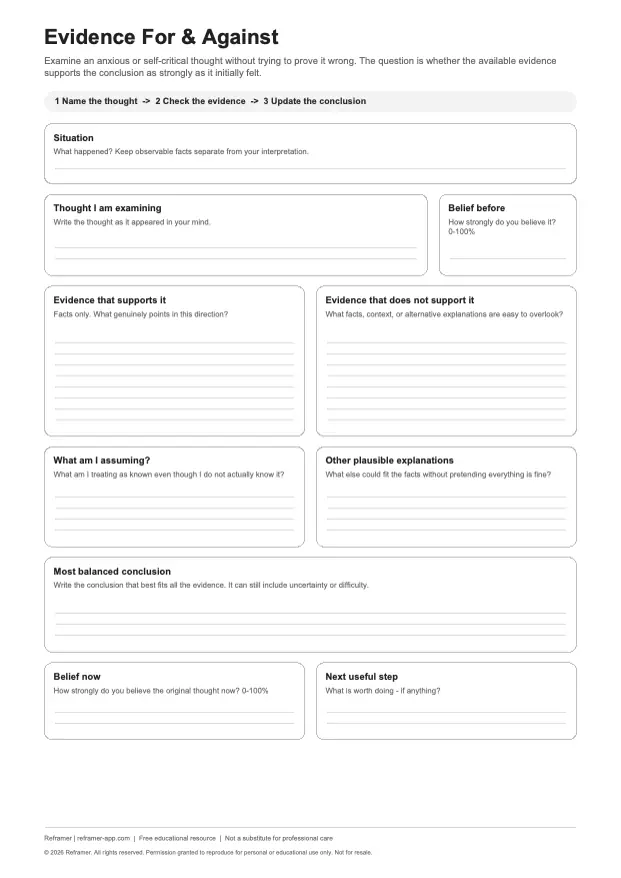
An evidence for and against worksheet helps you test how strongly the available facts support an anxious or self-critical thought. Write the thought, look at evidence on both sides, separate assumptions from observations and form the conclusion that best fits what you know. The aim is not to force a positive interpretation or prove the thought wrong. A negative concern may be partly supported, fully supported or still uncertain. This CBT evidence worksheet makes room for each possibility and ends with a useful next step rather than a promise of reassurance.
Free · A4 · Printable · Fillable PDF · No sign-up
Fillable fields work in most modern PDF readers. If your browser does not save entries correctly, download the PDF and open it in a compatible PDF app.
Entries typed into the downloaded worksheet remain in your PDF file; this page does not receive the text you enter.
What this worksheet helps with
- Testing an anxious or self-critical conclusion
- Distinguishing observable facts from assumptions
- Considering relevant context without dismissing real concerns
- Deciding what is worth doing next
When to use it
- When an ambiguous response feels like a definite rejection
- When you have a specific thought to examine
- When you can identify relevant evidence without repeatedly checking for reassurance
How to use the worksheet
Situation and thought I am examining
Describe the event using observable facts, then write the thought as specifically as possible. Keep what happened separate from what you think it means.
Belief before
Rate how strongly you believe the thought from 0–100%. This records your starting point, not how true the thought must be.
Evidence that supports it
Ask: what observable facts genuinely point in this direction? Include information that supports a real concern rather than excluding it to reach a reassuring answer.
Evidence that does not support it
Ask: what facts make this conclusion less certain or suggest another interpretation? Look for relevant context and exceptions, rather than inventing a positive explanation.
What am I assuming?
Separate predictions, interpretations and mind reading from what you actually know. “She replied briefly” is an observation; “She dislikes my work” may be an assumption.
Other plausible explanations
Consider what else fits the same facts without pretending everything is fine. If useful, ask what you would say to someone you cared about as perspective-taking rather than forced reassurance.
Conclusion that best fits the evidence
Account for both sides. The most balanced conclusion may acknowledge that the original concern is partly supported, that action is needed, or that the answer remains uncertain.
Belief now and next useful step
Rate belief in the original thought again from 0–100%. Choose a proportionate action, question or stopping point. A rating that does not fall is still useful information.
Completed example
The same everyday scenario appears in the completed-example PDF. It illustrates one possible response, rather than an answer you need to copy.
- Situation
- I sent a project proposal to my director. She replied, “Thanks - can we discuss this tomorrow?”
- Thought I am examining
- “She thinks the proposal is poor, and I have probably blown my chance to lead the project.”
- Belief before
- 85%.
- Evidence that supports it
- She did not approve the proposal in the email. One budget estimate is still rough and may need more explanation.
- Evidence that does not support it
- She called the proposal a “good start” last week. She often discusses proposals before deciding. She did not reject it or criticize my overall work.
- What am I assuming?
- I am assuming that “let us discuss” means bad news, that one weak estimate ruins the whole proposal, and that I already know her judgment.
- Other plausible explanations
- She may want clarification, especially on the budget. She may prefer discussing decisions live. The proposal may be promising but unfinished.
- Most balanced conclusion
- She wants to discuss the proposal, and one budget figure is worth preparing to explain. I do not yet know whether she will approve it or what she thinks of my ability to lead the project.
- Belief now
- 45%.
- Next useful step
- Prepare two questions, review the budget once, then stop.
Tips for getting more from the exercise
- Use relevant observations, not the intensity of a feeling, as evidence for the conclusion.
- A balanced conclusion can still acknowledge difficulty or a genuine problem.
- Set a stopping point; repeatedly completing the sheet to feel certain can turn it into another reassurance check.
What this worksheet cannot tell you
This worksheet cannot reveal another person's thoughts, guarantee an outcome or settle a question when evidence is missing. It does not ask you to dismiss harmful behavior or avoid practical action when the facts support a concern.
Related guides
Explore the ideas behind this exercise.
Related worksheets
CBT Thought Record
Examine a situation, its automatic thought, your emotions, the evidence and a more balanced response.
How to use this worksheetCognitive Reframing Worksheet
Examine an upsetting interpretation and develop a more accurate and useful way of seeing the situation.
How to use this worksheetCognitive Distortions Worksheet
Look for thinking patterns such as catastrophizing, mind reading and all-or-nothing thinking without assuming the thought is false.
How to use this worksheetBehavioral Experiment Worksheet
Turn an anxious belief into a testable prediction, plan a safe experiment and compare expectations with observations.
How to use this worksheetPrefer a guided experience?
Reframer brings some of the same principles into a guided experience: examining a thought, making a plan, allowing uncertainty or testing a prediction. Sometimes you need a reframe. Sometimes you need a plan.
These worksheets are provided for education and self-reflection. They are not a diagnosis, medical advice or a substitute for care from a qualified healthcare or mental-health professional. These worksheets may be downloaded, printed and reproduced for personal or educational use. They may not be resold, repackaged as another product, or redistributed commercially without prior permission.