

Panic Cycle Worksheet
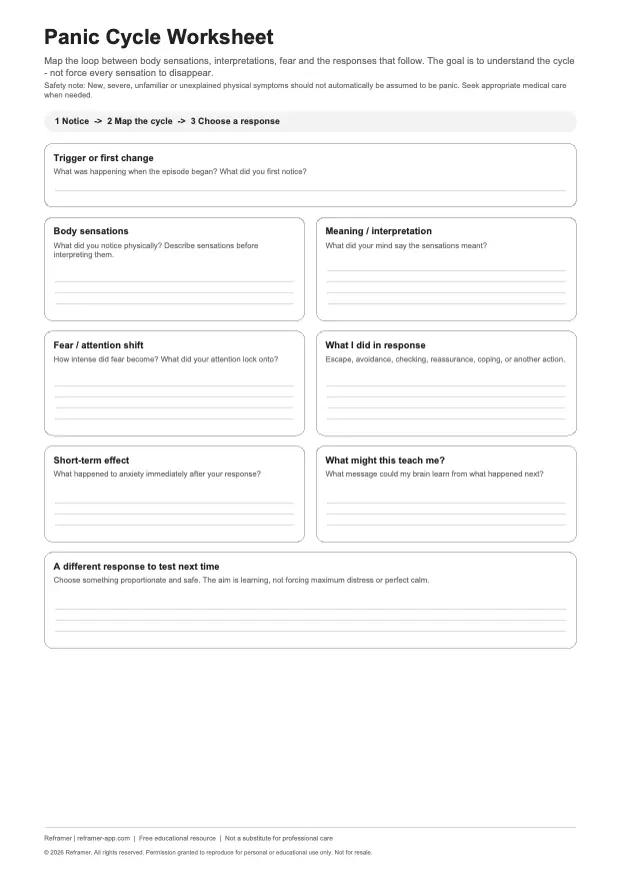
A panic cycle worksheet maps the feedback loop between body sensations, interpretations, fear and the responses that follow. A sensation may feel frightening; monitoring it closely or predicting danger can increase fear and change what you notice next. Escaping or checking may bring short-term relief while leaving the feared interpretation untested. These influences can run in both directions. Panic is a real experience, and this panic CBT worksheet neither diagnoses an episode nor assumes that all physical symptoms come from anxiety. Use it to understand a familiar, appropriately assessed pattern rather than force every sensation to disappear.
Free · A4 · Printable · Fillable PDF · No sign-up
Fillable fields work in most modern PDF readers. If your browser does not save entries correctly, download the PDF and open it in a compatible PDF app.
Entries typed into the downloaded worksheet remain in your PDF file; this page does not receive the text you enter.
What this worksheet helps with
- Mapping a familiar fear-of-fear loop
- Separating body sensations from the meanings attached to them
- Noticing escape, checking and other safety behaviors
- Considering a proportionate response to an assessed panic pattern
When to use it
- After a familiar episode, when you can reflect on what happened
- When similar, medically assessed sensations repeatedly lead to checking or escape
- When discussing a panic pattern with a qualified professional
How to use the worksheet
Trigger or first change
Record what was happening and what you first noticed. A trigger may be an event or a body sensation; you do not need to identify a single cause.
Body sensations
Describe sensations before interpreting them: a racing heart, dizziness, breathlessness, chest tightness, tingling, trembling or feeling unreal. This is a description, not a judgment about their medical cause.
Meaning / interpretation
Write what your mind said the sensation meant, such as “I am going to faint,” “Something is wrong with my heart,” or “Everyone will notice.” Keep the sensation and its interpretation separate.
Fear / attention shift
Note how intense fear became and what your attention locked onto. Describe changes in breathing, anxiety or sensations as part of a feedback loop rather than a fixed sequence.
What I did in response
Record escape, avoidance, checking, reassurance or coping: leaving, checking your pulse, searching symptoms or trying to control breathing. Do not classify medically appropriate precautions as unnecessary safety behaviors.
Short-term effect
What changed immediately after the response? Note relief, continued distress or another outcome without assuming that relief proves the sensation was dangerous.
What might this teach me?
Consider the message you might learn, such as “I can only cope if I escape.” This is a possible learning pattern, not a diagnosis or criticism of how you coped.
A different response to test next time
For a familiar, appropriately assessed pattern, consider one safe, proportionate response with professional guidance where needed. Keep genuine precautions and seek medical care for new or concerning symptoms. The goal is learning rather than maximum distress or perfect calm.
Completed example
The same everyday scenario appears in the completed-example PDF. It illustrates one possible response, rather than an answer you need to copy.
- Trigger or first change
- I was waiting to present in a quarterly team meeting. Two minutes before my turn, my heart suddenly started pounding.
- Body sensations
- Heart pounding; shallow-feeling breathing; tingling in my fingers; light-headed; hot face.
- Meaning / interpretation
- “I am going to faint in front of everyone. If this gets worse, I will lose control and embarrass myself.”
- Fear / attention shift
- Fear rose to about 90/100. I started monitoring every heartbeat and checking whether the room looked blurry.
- What I did in response
- I stepped into the hallway, checked my pulse several times, drank water, and asked a colleague to present before me.
- Short-term effect
- Relief was immediate. Anxiety dropped from about 90/100 to 55/100 after I left the room.
- What might this teach me?
- “A fast heartbeat means I am in danger, and I need to escape or check my pulse before I can cope.”
- A different response to test next time
- Because I have previously had similar episodes medically assessed, I could stay seated for two minutes, keep my feet on the floor, let my breathing stay comfortable, and describe the sensations without adding the prediction that I will faint. If symptoms are unfamiliar or concerning, I would seek medical help instead.
Tips for getting more from the exercise
- Complete the worksheet after an episode rather than turning it into another way to monitor symptoms repeatedly.
- Use your own words for the interpretation; you do not need to dispute every thought.
- Keep genuine precautions. Discuss changes to familiar panic responses with a qualified professional if you are unsure.
What this worksheet cannot tell you
This worksheet cannot diagnose panic attacks, rule out a medical condition or establish that a sensation is safe. It cannot replace assessment or individualized treatment. Do not use it to delay medical care, change medication or attempt unsafe exposure exercises.
Related guides
Explore the ideas behind this exercise.
Related worksheets
CBT Triangle Worksheet
See how thoughts, emotions and behaviors influence one another in a situation, with body sensations and possible points of intervention included.
How to use this worksheetA Reframer exercise
Facts, Predictions & Actions Worksheet
Separate what you know from what your mind predicts, then identify whether there is anything useful you can do.
How to use this worksheetCognitive Reframing Worksheet
Examine an upsetting interpretation and develop a more accurate and useful way of seeing the situation.
How to use this worksheetBehavioral Experiment Worksheet
Turn an anxious belief into a testable prediction, plan a safe experiment and compare expectations with observations.
How to use this worksheetPrefer a guided experience?
Reframer brings some of the same principles into a guided experience: examining a thought, making a plan, allowing uncertainty or testing a prediction. Sometimes you need a reframe. Sometimes you need a plan.
These worksheets are provided for education and self-reflection. They are not a diagnosis, medical advice or a substitute for care from a qualified healthcare or mental-health professional. These worksheets may be downloaded, printed and reproduced for personal or educational use. They may not be resold, repackaged as another product, or redistributed commercially without prior permission.